Introduction
Investors today have access to more financial options than ever before. Alongside traditional choices such as fixed deposits, mutual funds and bonds, Peer-to-Peer (P2P) lending has emerged as an alternative way to participate in lending.
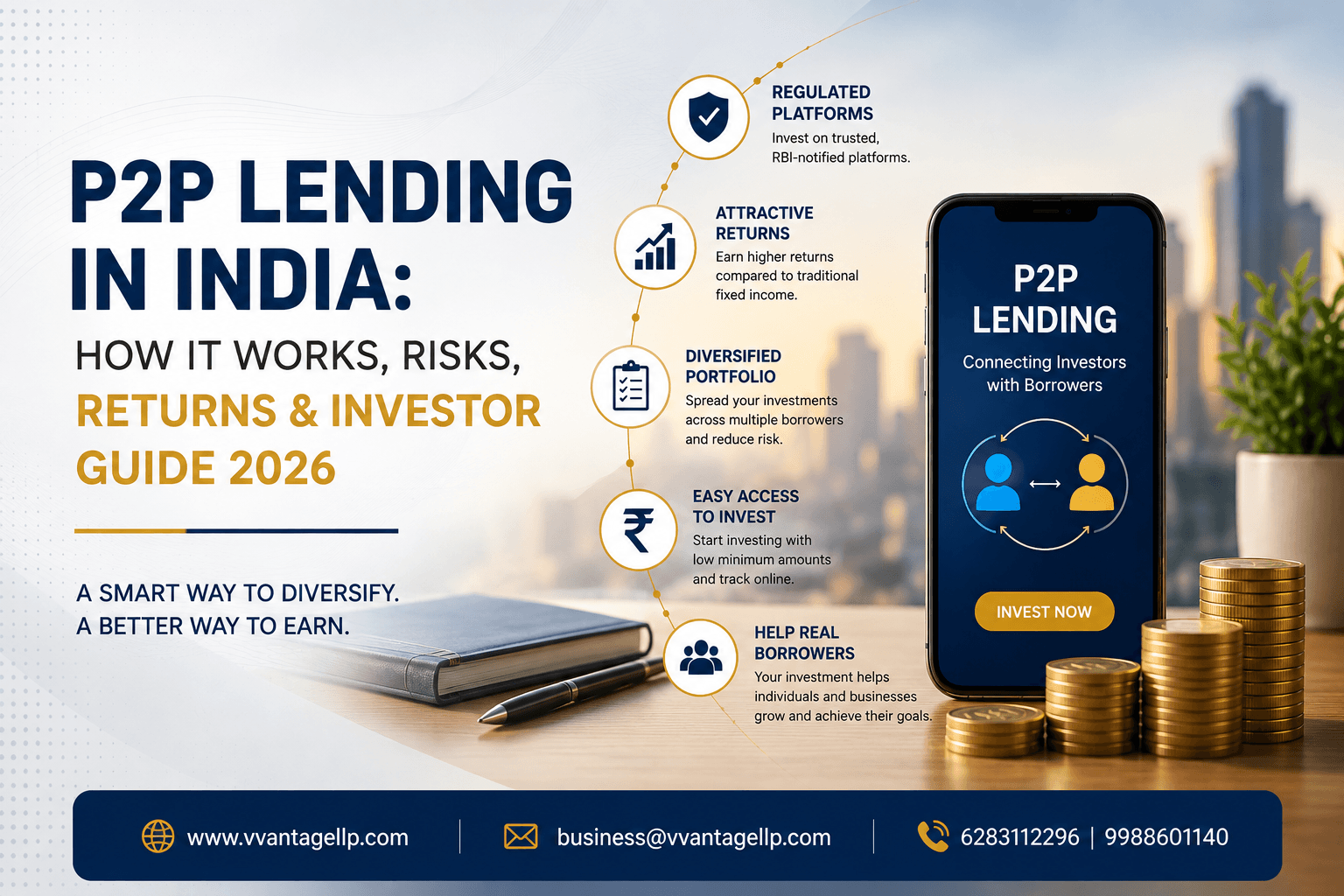
P2P lending connects individuals who want to borrow money with individuals who are willing to lend it through an online platform. Instead of the traditional model where a bank stands between the borrower and lender, a regulated P2P platform facilitates the connection and related processes.
However, P2P lending should not be viewed simply as another high-return investment option. It involves credit risk, potential loss of principal, liquidity considerations and borrower default risk.
For investors considering P2P lending in India, understanding how the model works, what regulations apply, how returns are generated and what can go wrong is essential.
What Is P2P Lending?
Peer-to-Peer lending is a technology-enabled lending model where individuals can lend money to other individuals or eligible borrowers through a P2P platform.
The platform acts as an intermediary. It facilitates the process of bringing lenders and borrowers together rather than lending its own money to borrowers.
In India, P2P lending platforms operate under the Non-Banking Financial Company – Peer to Peer Lending Platform (NBFC-P2P) framework regulated by the Reserve Bank of India (RBI). RBI introduced the regulatory framework in 2017, and the directions have subsequently been updated.
An important point for investors is that the platform itself does not guarantee repayment of the money lent. Under the RBI framework, lenders bear the credit risk associated with the loans they fund.
How Does P2P Lending Work?
The process is relatively straightforward.
1. Borrowers Apply for Loans
A borrower approaches a P2P platform and submits the required information and documentation.
Depending on the platform’s process, the borrower may be assessed based on factors such as income, repayment history, existing obligations and other credit-related information.
2. The Platform Evaluates the Borrower
The P2P platform facilitates the assessment and categorisation of borrowers according to its internal processes.
Investors should remember that borrower assessment reduces risk but does not eliminate it.
A borrower who appears financially suitable at the time of lending can still face financial difficulties later.
3. Investors Select Lending Opportunities
Registered lenders can review available lending opportunities and decide where they are comfortable deploying their funds.
The investor should consider factors such as:
- Borrower profile
- Interest rate
- Loan tenure
- Expected repayment schedule
- Historical performance data
- Platform fees
- Default and recovery information
- Portfolio diversification
4. Funds Are Facilitated Through the Platform
The platform facilitates the movement of funds and the servicing of loans within the regulatory framework.
RBI’s directions require P2P platforms to operate as intermediaries rather than using lenders’ funds for their own purposes or replacing one lender’s funds with another lender’s funds.
5. Borrowers Repay the Loan
The borrower makes repayments according to the agreed schedule.
For the lender, these repayments generally consist of principal and interest.
If a borrower defaults, however, the lender may experience delayed payments or a loss of principal and/or interest.
How Do Investors Earn Returns From P2P Lending?
The basic return mechanism is interest received from borrowers.
For example, suppose an investor lends ₹1,00,000 across several loans at different interest rates. If borrowers make their scheduled repayments, the investor receives interest along with principal repayments.
But there is an important distinction between interest rate and actual investment return.
An advertised or agreed interest rate does not necessarily represent the investor’s final return.
The actual outcome can be affected by:
- Borrower defaults
- Delayed repayments
- Loan recoveries
- Platform fees
- Taxes
- Idle cash
- Reinvestment opportunities
- Loss of principal
Therefore, investors should evaluate net realised returns after considering losses and costs, rather than focusing only on the headline interest rate.
Are P2P Returns Guaranteed?
No.
This is one of the most important points investors should understand before entering P2P lending.
RBI’s P2P framework requires lenders to acknowledge that the platform does not assure the return of principal or payment of interest. It also recognises the possibility of losing the entire principal if a borrower defaults.
Therefore, P2P lending should not be treated as a guaranteed-return product.
A platform may have sophisticated borrower assessment and collection processes, but these cannot completely eliminate credit risk.
Key Risks of P2P Lending
P2P lending can provide an alternative avenue for investors, but it comes with meaningful risks.
1. Credit Risk
Credit risk is the possibility that a borrower may fail to repay the loan.
This is arguably the most important risk in P2P lending.
Even if a borrower has a good credit profile when the loan is issued, circumstances can change. Job loss, business difficulties, unexpected expenses or excessive debt can affect repayment ability.
2. Risk of Principal Loss
Unlike a guaranteed deposit, P2P lending does not assure the return of your principal.
If a borrower defaults and recovery efforts are unsuccessful, the lender may lose part or potentially all of the amount lent.
RBI specifically requires P2P platforms to disclose this risk to lenders.
3. Liquidity Risk
Money lent through P2P loans may not be as easily accessible as money held in a savings account.
Loan maturities can extend over a period of time, and investors should not assume that they can always exit their lending positions immediately.
Under the RBI framework, the maturity of loans facilitated through P2P platforms cannot exceed 36 months.
4. Concentration Risk
Lending a large portion of your money to one borrower can significantly increase portfolio risk.
If that borrower defaults, a substantial portion of your capital could be affected.
This makes diversification an important consideration.
5. Platform Risk
Investors should also understand the role and limitations of the P2P platform.
A regulated platform is required to follow the applicable RBI framework, but regulation does not mean that every loan will perform successfully.
Investors should therefore distinguish between platform regulation and investment performance.
6. Return Variability
The return an investor actually earns can differ from the initial interest rate because defaults, delays, recoveries and costs can change the final outcome.
This is why historical portfolio performance can be more informative than simply looking at the highest interest rate offered.
Why Diversification Matters in P2P Lending
One of the practical ways investors can manage concentration risk is by spreading their lending exposure across multiple borrowers.
For example, instead of lending ₹50,000 to one borrower, an investor may consider distributing the amount across several eligible loans, subject to the applicable rules and their own risk tolerance.
Diversification cannot eliminate default risk, but it can reduce the impact that one borrower has on the overall portfolio.
Investors should also consider diversification across:
- Borrowers
- Loan sizes
- Risk categories
- Loan tenures
- Income profiles
- Repayment patterns
The objective is not simply to have many loans, but to avoid excessive dependence on a small number of borrowers.
What Does RBI Regulation Mean for P2P Investors?
P2P lending platforms in India are regulated as NBFC-P2Ps under RBI’s regulatory framework.
The framework sets requirements around the activities that P2P platforms can undertake and the way lender and borrower funds are handled. NBFC-P2Ps are intermediaries and cannot lend from their own balance sheets in the manner of a conventional lender.
RBI’s framework also places limits on lending and borrowing exposures. For example, the aggregate loans taken by a borrower across P2P platforms are subject to a ₹10 lakh cap, while a single lender’s exposure to the same borrower across P2P platforms is subject to a ₹50,000 limit under the stated framework.
RBI has also highlighted supervisory concerns and issued clarifications in 2024 relating to matters such as lender-fund deployment, fee disclosures, escrow-account handling and disclosure of portfolio performance, including losses borne by lenders and NPAs.
For investors, the key takeaway is simple:
Regulation provides a framework for how P2P platforms must operate, but it does not guarantee investment returns.
What Should You Check Before Investing in P2P Lending?
Before committing money, investors should conduct their own due diligence.
Check 1: Is the Platform an RBI-Registered NBFC-P2P?
Verify the regulatory status of the platform rather than relying solely on advertisements or marketing claims.
Check 2: Understand the Default History
Look beyond the advertised interest rate.
Review available information on:
- Delinquency
- Defaults
- NPAs
- Recoveries
- Principal losses
- Portfolio performance
Check 3: Understand the Fees
Platform fees can affect your net returns.
RBI has emphasised objective pricing policies and disclosure of fees applicable to lending transactions.
Check 4: Understand the Recovery Process
Ask what happens when a borrower stops paying.
Understand the platform’s collection and recovery process and how recoveries are distributed to lenders.
Check 5: Review Loan Tenure
Consider whether you are comfortable keeping your money deployed for the applicable loan period.
Check 6: Avoid Chasing the Highest Rate
A higher interest rate can indicate higher borrower risk.
Instead of asking, “Which loan gives me the highest return?”, consider asking:
“Does the potential return adequately compensate me for the risk I am taking?”
P2P Lending vs Traditional Investment Options
P2P lending is different from traditional savings and investment products.
A fixed deposit may offer greater predictability of returns, subject to applicable terms and protections.
Equity investments can provide higher long-term growth potential but generally come with market volatility.
P2P lending is primarily exposed to borrower credit risk.
Therefore, the right choice depends on an investor’s:
- Financial goals
- Risk tolerance
- Investment horizon
- Liquidity requirements
- Existing portfolio
- Ability to absorb potential losses
There is no single investment product that is suitable for every investor.
Is P2P Lending Suitable for Everyone?
Not necessarily.
P2P lending may be considered by investors who understand credit risk and are financially capable of absorbing potential losses.
It may be less suitable for someone who:
- Needs guaranteed returns
- Cannot tolerate principal loss
- Needs immediate access to invested funds
- Is investing money required for near-term expenses
- Is choosing the product solely because of a high advertised interest rate
Before investing, investors should consider whether P2P lending fits within their broader financial plan rather than treating it as a standalone opportunity.
A Smarter Way to Approach P2P Lending
A disciplined approach can be more valuable than simply looking for the highest return.
Consider the following framework:
Understand → Assess → Diversify → Monitor → Review
Understand
Learn how P2P lending works and what risks are involved.
Assess
Evaluate the platform, borrower information, historical performance, fees and recovery process.
Diversify
Avoid excessive exposure to any single borrower or risk segment.
Monitor
Track repayment performance and portfolio-level results.
Review
Regularly evaluate whether P2P lending continues to fit your financial objectives and risk profile.
This approach shifts the focus from “How much can I earn?” to “How much risk am I taking to earn that return?”
Final Thoughts
P2P lending has introduced a technology-driven way for lenders and borrowers to connect outside the traditional banking model.
For investors, it can offer an alternative source of interest income, but the opportunity comes with genuine risks. Returns are not guaranteed, principal can be lost, and borrower defaults can affect overall portfolio performance.
The most important step is therefore not selecting the loan with the highest interest rate. It is understanding the relationship between risk, expected return, diversification, liquidity and your personal financial objectives.
Investors should conduct appropriate due diligence and consider professional financial advice where necessary before making investment decisions.
At Vvantagellp, the focus is on helping clients approach financial decisions with greater clarity, structured thinking and an understanding of both opportunities and risks.
Our approach emphasizes clarity, risk awareness and long-term financial objectives rather than focusing solely on short-term returns.
Through its financial advisory and consulting services, Vvantagellp helps clients evaluate financial opportunities, understand risks and make decisions aligned with their individual or business requirements.
Frequently Asked Questions (FAQs)
1. What is P2P lending in India?
P2P lending is a lending model where individuals can lend money to borrowers through an online platform. In India, eligible P2P platforms operate as NBFC-P2Ps under the regulatory framework of the Reserve Bank of India.
2. Is P2P lending regulated by RBI?
Yes. P2P platforms in India are regulated under the RBI’s NBFC-P2P framework. However, RBI regulation does not mean that investments or returns are guaranteed.
3. Is P2P lending safe?
P2P lending involves risk and should not be considered risk-free. Borrower defaults can result in delayed payments or loss of principal. Investors should understand these risks before lending.
4. Can I lose my money in P2P lending?
Yes. There is a possibility of losing part or potentially all of the principal associated with a loan if the borrower defaults and recovery is unsuccessful. RBI requires lenders to acknowledge this risk.
5. Are P2P lending returns guaranteed?
No. P2P platforms cannot assure lenders of the return of principal or payment of interest. Actual returns can be affected by defaults, delays, recoveries and fees.
6. How long can P2P loans run?
Under the RBI framework, the maturity of loans facilitated through NBFC-P2P platforms cannot exceed 36 months.
7. Why is diversification important in P2P lending?
Diversification can reduce the impact of a single borrower defaulting. Spreading funds across multiple borrowers and suitable risk categories can help manage concentration risk, although it cannot eliminate the possibility of losses.
8. What should I check before choosing a P2P platform?
Check the platform’s RBI registration status, fee structure, borrower assessment approach, historical portfolio performance, default and recovery data, loan tenure and risk disclosures.
9. Is P2P lending better than fixed deposits?
Neither is universally better. They have different risk and return characteristics. P2P lending carries borrower credit risk and potential principal loss, while fixed deposits generally offer greater predictability subject to the applicable terms and protections. Investors should compare products according to their financial goals and risk tolerance.
10. Should beginners invest in P2P lending?
Beginners should first understand how P2P lending works and the possibility of principal loss. It should only be considered if the investor understands the risks, has appropriate liquidity and is comfortable with the possibility of credit-related losses.
11. Does a higher P2P interest rate mean a better investment?
Not necessarily. A higher rate can come with greater borrower risk. Investors should evaluate expected return alongside default probability, historical performance, diversification, fees and recovery outcomes.
12. Is P2P lending suitable for long-term wealth creation?
P2P lending can be one component of a diversified financial strategy for some investors, but it should not automatically be treated as a replacement for long-term investments such as diversified equity or other suitable asset classes. The appropriate mix depends on the investor’s goals, time horizon and risk profile.
