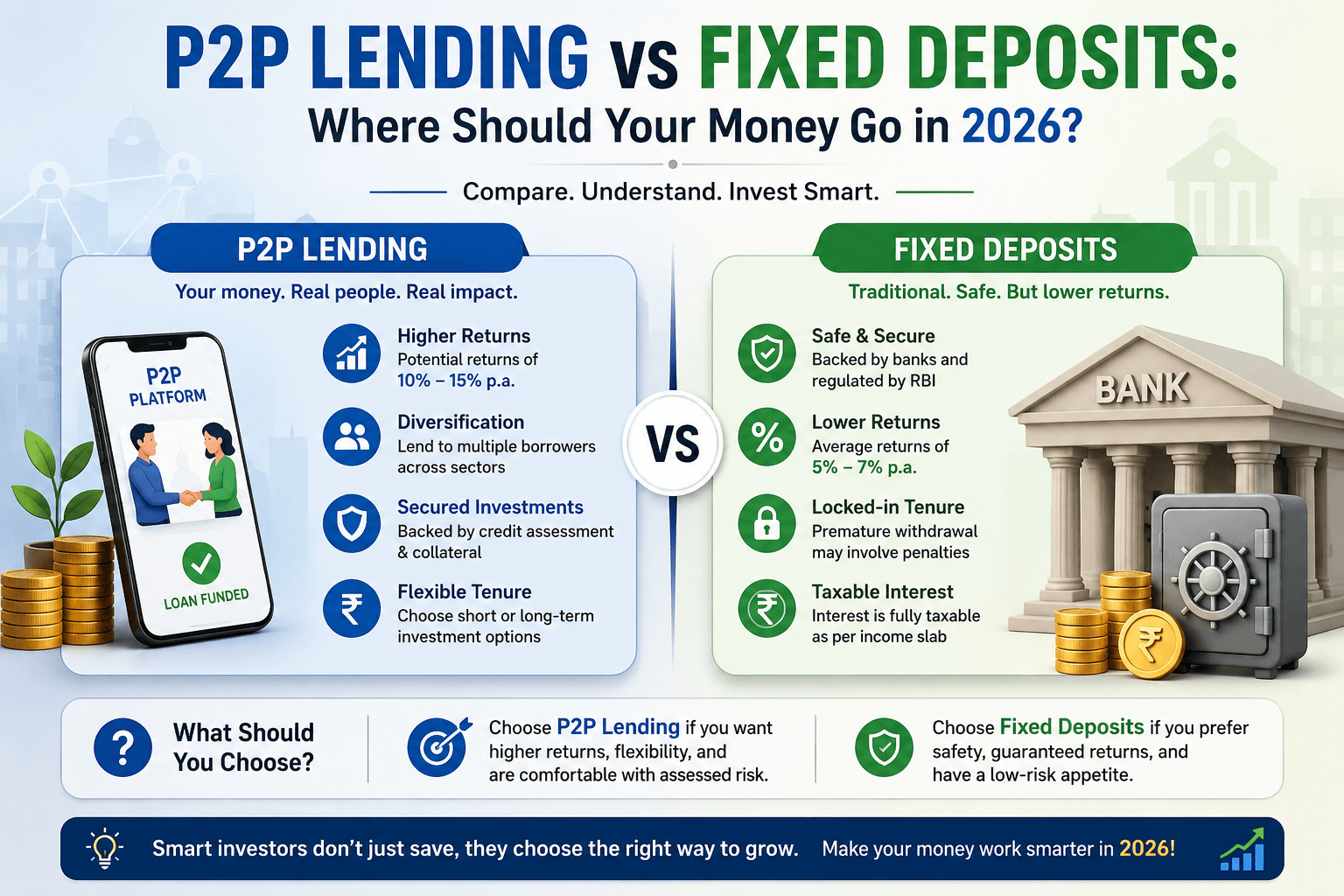
For decades, Fixed Deposits (FDs) have been the default choice for Indian savers. They are familiar, easy to understand, and considered relatively safe. But as financial markets evolve and investors look for alternatives that can potentially offer better returns, another option has gained attention: Peer-to-Peer (P2P) Lending.
If you’re wondering whether your money should go into a Fixed Deposit or P2P Lending in 2026, you’re not alone.
The answer isn’t as simple as choosing one over the other. Both serve different purposes and suit different types of investors.
In this guide, we’ll compare P2P Lending and Fixed Deposits across returns, risk, liquidity, taxation, and portfolio suitability so that you can make a more informed decision.
What Is a Fixed Deposit?
A Fixed Deposit is a financial product offered by banks and certain financial institutions where you deposit a lump sum amount for a fixed tenure and earn interest on it.
Key characteristics:
- Predetermined interest rate
- Fixed tenure
- Predictable returns
- Relatively low risk
- Suitable for conservative investors
Because returns are known in advance, many investors use FDs for emergency funds, short-term goals, and capital preservation.
What Is P2P Lending?
Peer-to-Peer (P2P) Lending is an investment model where investors lend money directly to borrowers through regulated online platforms.
Instead of depositing money with a bank, investors provide funds to individual borrowers and earn interest from repayments.
P2P platforms typically:
- Verify borrower profiles
- Assess creditworthiness
- Categorize risk levels
- Manage collections
- Handle repayments
This creates an alternative investment avenue that operates independently of stock market performance.
Why Is P2P Lending Becoming Popular in 2026?
Several factors have contributed to growing interest in P2P lending:
1. Search for Better Returns
Many investors feel traditional savings options struggle to keep pace with rising living costs.
2. Portfolio Diversification
Investors increasingly want investments that are not directly linked to stock market fluctuations.
3. Digital Financial Ecosystem
Technology has made lending and investing more accessible than ever.
4. Growing Financial Awareness
People today are exploring multiple asset classes instead of relying solely on traditional products.
P2P Lending vs Fixed Deposits: Side-by-Side Comparison
| Factor | Fixed Deposits | P2P Lending |
| Return Potential | Generally moderate | Potentially higher |
| Risk Level | Lower | Moderate |
| Market Dependency | Not linked to stock market | Not linked to stock market |
| Liquidity | Depends on FD terms | Usually lower liquidity |
| Diversification Benefit | Limited | Strong when diversified |
| Return Frequency | Monthly/Quarterly/Maturity | Daily, Weekly, or Monthly depending on platform |
| Capital Protection | Relatively stronger | Subject to borrower repayment performance |
| Investor Involvement | Minimal | Requires monitoring and diversification |
Returns: The First Thing Most Investors Look At
When comparing investment options, returns often become the biggest deciding factor.
Fixed Deposits generally provide predictable interest income. Investors know in advance what they are likely to earn.
P2P lending, on the other hand, offers the possibility of higher returns because investors are lending directly to borrowers.
However, higher potential returns typically come with additional risk considerations.
The important takeaway:
Higher return opportunities should always be evaluated alongside risk management.
Risk: Understanding the Difference
Many people assume risk means losing everything.
In reality, risk simply refers to uncertainty.
Fixed Deposit Risk
FDs are generally viewed as lower-risk instruments.
Primary risks include:
- Inflation reducing purchasing power
- Reinvestment risk when rates change
- Limited wealth growth potential
P2P Lending Risk
P2P lending carries additional considerations:
- Borrower default risk
- Liquidity risk
- Platform-related risk
However, diversification can significantly reduce concentration risk.
For example, investing ₹1,00,000 across 200 borrowers is generally very different from lending ₹1,00,000 to just one borrower.
The Inflation Challenge
One of the biggest financial threats is not market volatility.
It’s inflation.
Imagine:
- Inflation = 6%
- Investment return = 6%
Your purchasing power has effectively remained unchanged.
This is why investors increasingly evaluate whether their investments are helping them stay ahead of rising costs.
The goal isn’t simply to earn returns.
The goal is to preserve and grow purchasing power over time.
A Factor Many Investors Ignore: Liquidity
Liquidity refers to how quickly you can access your money.
Fixed Deposits
Many FDs allow premature withdrawal, although penalties may apply.
P2P Lending
P2P investments are generally tied to borrower repayment schedules.
This means funds may remain invested until repayments are completed.
Investors who may need immediate access to capital should carefully consider liquidity before investing.
Daily, Weekly, and Monthly Income Potential
One reason some investors explore P2P lending is the possibility of receiving regular repayments.
Depending on platform structure, repayments may be:
- Daily
- Weekly
- Monthly
This creates a recurring cash-flow experience that some investors find attractive.
Fixed Deposits generally provide:
- Monthly payouts
- Quarterly payouts
- Annual payouts
- Maturity payouts
The choice depends on personal cash-flow requirements.
Is P2P Lending Connected to the Stock Market?
One feature that attracts many investors is that P2P lending is generally not directly linked to stock market movements.
When stock markets experience volatility:
- Borrower repayments continue according to schedules
- Returns are driven by lending activity rather than market sentiment
This makes P2P lending an alternative asset class from a portfolio diversification perspective.
Who Might Prefer Fixed Deposits?
Fixed Deposits may suit:
- Conservative investors
- Retirees seeking stability
- Investors prioritizing capital preservation
- Individuals with short-term goals
- Emergency fund allocations
Who Might Consider P2P Lending?
P2P lending may appeal to:
- Investors seeking diversification
- Investors comfortable with moderate risk
- Individuals exploring alternatives beyond traditional products
- Investors seeking recurring cash flow
- Long-term investors building diversified portfolios
A Smarter Approach: Why It Doesn’t Have to Be Either/Or
One of the biggest investing misconceptions is believing every decision must be all-or-nothing.
Many successful investors use multiple asset classes together.
For example:
- Emergency funds in highly liquid instruments
- Fixed Deposits for stability
- Mutual Funds for growth potential
- P2P Lending as an alternative allocation
Diversification helps reduce dependence on any single investment type.
Example Portfolio Thinking
Consider two investors.
Investor A
Keeps 100% of savings in Fixed Deposits.
Advantages:
- Stability
- Predictability
Challenges:
- Limited growth potential
Investor B
Builds a diversified portfolio including:
- Emergency reserve
- Fixed Deposits
- Mutual Funds
- Limited allocation to P2P Lending
Advantages:
- Diversification
- Multiple income sources
- Better balance between stability and growth
This illustrates how portfolio construction often matters more than selecting a single investment.
Common Mistakes Investors Make
Chasing Only Returns
Higher returns without understanding risk can create problems.
Ignoring Diversification
Putting all money into one asset class increases concentration risk.
Investing Without Goals
Every investment should serve a purpose.
Overlooking Liquidity Needs
Investors should ensure they have accessible funds for emergencies.
Final Verdict: Where Should Your Money Go in 2026?
The answer depends on your financial goals, risk tolerance, and investment horizon.
Choose Fixed Deposits if:
- Capital stability is your highest priority
- You have short-term financial goals
- You prefer predictable returns
Consider P2P Lending if:
- You want diversification
- You understand the associated risks
- You seek an alternative income-generating asset class
- You are willing to take a measured level of risk
For many investors, the most balanced approach may not be choosing one over the other.
It may be understanding how both can fit into a well-structured financial plan.
Quick Takeaways
✔ Fixed Deposits offer stability and predictability.
✔ P2P Lending offers diversification and potentially higher return opportunities.
✔ Neither investment is universally better.
✔ The right choice depends on goals, liquidity needs, and risk tolerance.
✔ Diversification remains one of the most effective long-term investing principles.
Frequently Asked Questions (FAQs)
1. Is P2P Lending safer than Fixed Deposits?
Generally, Fixed Deposits are considered lower risk, while P2P lending involves borrower repayment risk.
2. Can P2P Lending provide regular income?
Yes, depending on the platform structure, repayments may be received daily, weekly, or monthly.
3. Are P2P Lending returns guaranteed?
No. Returns depend on borrower repayments and platform performance.
4. Is P2P Lending linked to stock market movements?
Generally, P2P lending returns are not directly dependent on stock market performance.
5. Can I withdraw money anytime from P2P Lending?
Liquidity depends on the platform and loan tenure.
6. Who should invest in Fixed Deposits?
Investors seeking stability and predictable returns may prefer FDs.
7. How can investors reduce risk in P2P Lending?
Diversifying across multiple borrowers is one commonly used risk-management approach.
8. Can P2P Lending help diversify a portfolio?
Yes, many investors consider it an alternative asset class.
9. Which is better for short-term goals?
Fixed Deposits are often considered more suitable for short-term goals due to their predictability.
10. Is diversification important?
Yes. Diversification can help reduce concentration risk and improve portfolio balance.
About VVantage Edge LLP At VVantage Edge LLP, we believe financial decisions should be based on understanding, planning, and long-term thinking rather than short-term trends. Whether evaluating traditional options like Fixed Deposits or newer alternatives such as P2P Lending, informed decision-making remains one of the most important factors in achieving financial confidence and long-
