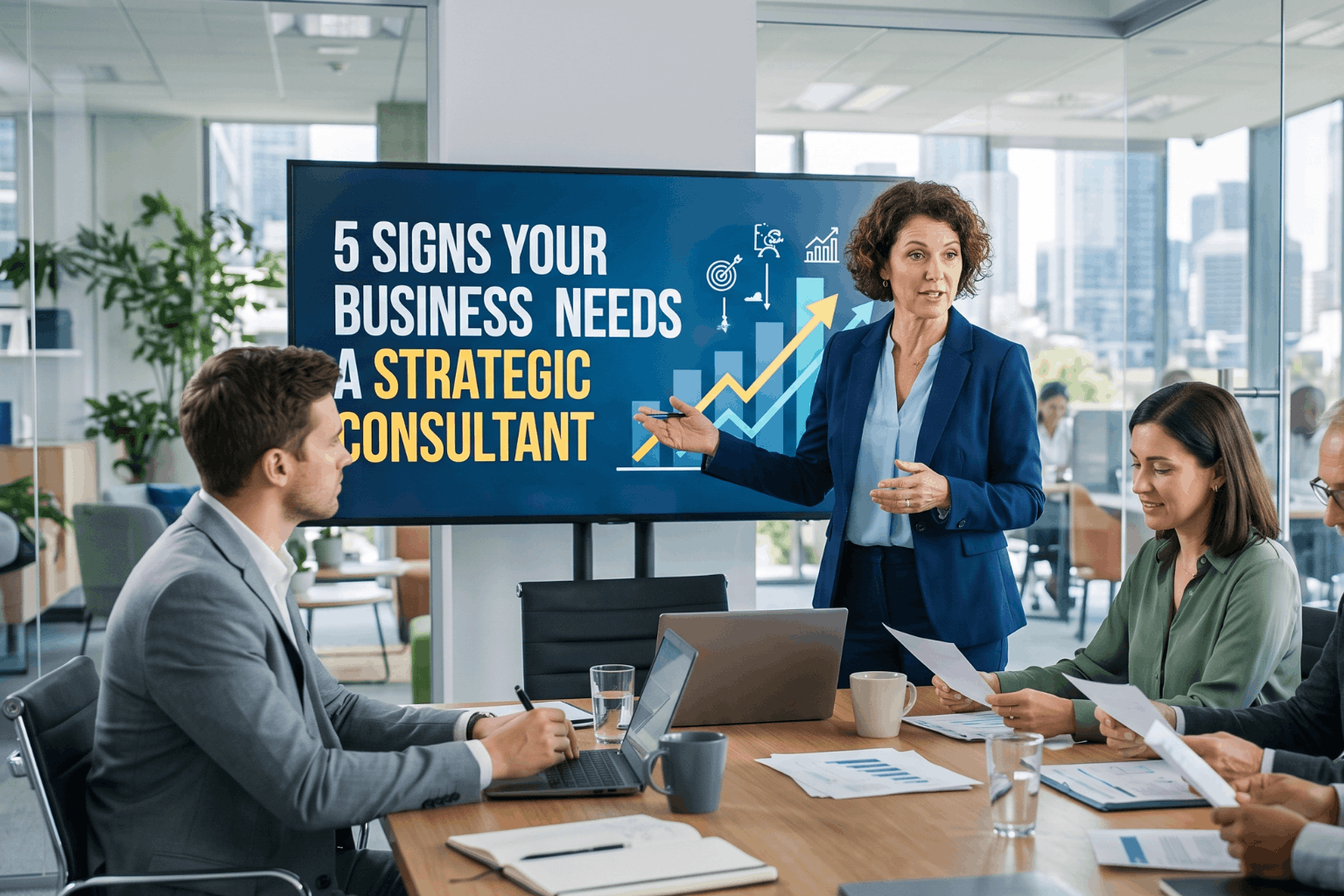
There’s a moment in almost every growing business where the team starts working harder, but the results stop matching the effort. Meetings get longer. To-do lists get fuller. Everyone’s busy — and yet the business feels like it’s treading water instead of moving forward.
The instinct in this moment is almost always the same: push harder. Add another hour to the day. Hire another junior employee. Launch another initiative. But hustle solves a capacity problem. It doesn’t solve a clarity problem — and more often than not, what’s actually missing isn’t effort. It’s strategy.
Here are five signs that what your business needs isn’t more hustle, but an outside strategic perspective — the kind of work we focus on in our strategy consulting practice at Vantage LLP.
1. You’re Busy, But Growth Has Plateaued
If revenue, margins, or market share have flattened even though the team is working more hours than ever, that’s rarely a motivation problem. It’s usually a sign that the current strategy has reached its ceiling.
Internal teams are often too close to the day-to-day to see this. They’re optimizing existing processes when what the business actually needs is a new approach — a different market segment, a repriced offering, a restructured sales process. This pattern shows up at scale, too: a well-known Harvard Business Review study of large-company growth found that the large majority of Fortune 100-size companies had hit a serious growth stall at some point over a fifty-year period, and that most of those stalls traced back to internal strategy and management decisions rather than outside market forces. In other words, plateaus are usually self-inflicted — and self-correctable with the right outside input.
A strategic consultant’s value isn’t working harder alongside your team; it’s stepping back far enough to see what more hustle can’t fix. See how we approach this in our growth strategy services.
2. Every Big Decision Feels Like a Guess
Growing businesses eventually hit decisions that are too big to make on gut instinct alone: entering a new market, restructuring a team, changing a pricing model, taking on outside investment. When leadership starts making these calls based on hope rather than a clear framework, that’s a signal.
A consultant brings a structured way to evaluate high-stakes decisions — one built on data, comparable case studies, and experience across other businesses that have faced the same fork in the road. That doesn’t remove the risk of a big decision, but it replaces guesswork with a defensible process. For a closer look at how this plays out for founders specifically, Harvard Business School’s overview of managerial decision-making is a useful primer on why structured frameworks consistently outperform intuition alone at scale.
3. Leadership Is Too Deep in Operations to Think Ahead
There’s a specific kind of busy that’s especially dangerous: when the people who should be setting direction are so buried in daily operations that no one is actually looking six or twelve months out.
If your leadership team can describe exactly what happened last week but struggles to describe where the business will be next year, that’s not a bandwidth issue that more hustle fixes. It’s a structural one. An outside consultant can hold the strategic view while leadership stays focused on execution — and can push leadership out of the weeds long enough to actually plan. This is often the first gap we address in our leadership advisory engagements.
4. The Same Problems Keep Resurfacing
Every business hits problems. But when the same issue — high employee turnover, inconsistent sales performance, missed project deadlines, customer churn — keeps reappearing despite repeated attempts to fix it, that’s usually a sign the root cause hasn’t actually been identified.
Internal teams tend to treat symptoms because they’re the ones living inside the system; it’s hard to diagnose a problem you’re also part of. A consultant’s outside vantage point is often what’s needed to trace a recurring issue back to its actual source, rather than patching it again. We’ve walked through this exact pattern in one of our recent client case studies, where a recurring operational bottleneck turned out to trace back to a single misaligned incentive structure.
5. You’ve Outgrown the Systems That Got You Here
The processes, org structure, and decision-making style that worked when the business was smaller often start to break down as it scales. What once felt efficient starts to feel chaotic. Communication that used to happen naturally now requires formal handoffs. Decisions that used to take a day now take three weeks.
This is one of the clearest signals that a business needs strategic help rather than more effort from its team. The people aren’t the problem — the systems built for an earlier stage of the business are. A strategic consultant can help redesign the operating model to match where the business actually is now, not where it was a year or two ago, which is the focus of our operating model design work.
Hustle Has a Ceiling. Strategy Doesn’t.
Hard work will always matter. But hard work inside the wrong strategy just produces more activity, not more results. If any of these five signs sound familiar, the next step isn’t a longer to-do list — it’s an outside perspective that can identify what’s actually holding the business back and build a clear path forward.
If you’re seeing these signs in your own business, get in touch with our team to talk through where a strategic consulting engagement could make the biggest difference.
